
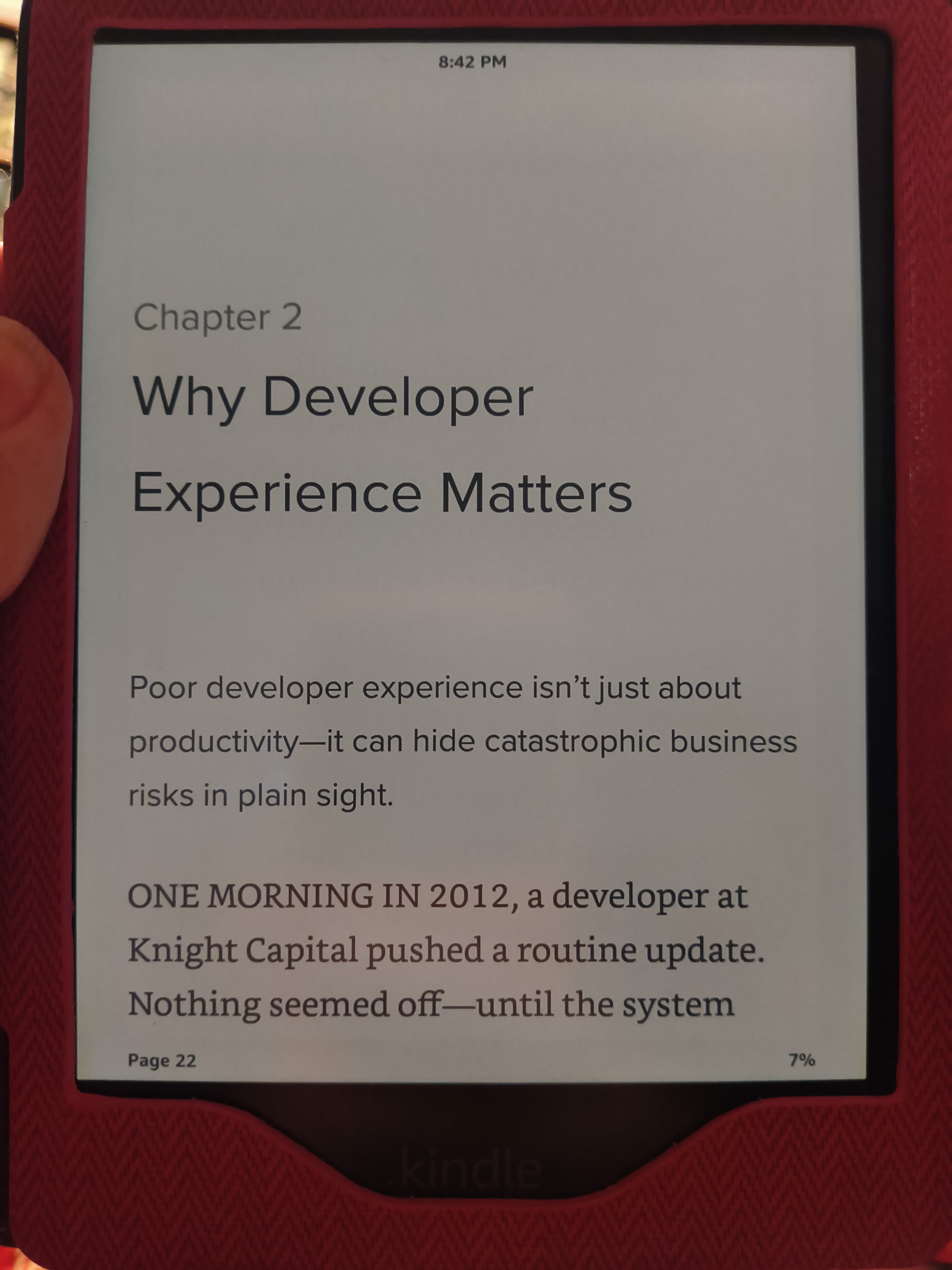
I’m halfway through Frictionless, and I think I understand something that I’ve been struggling with. The book deserves its own review, but here’s the thought I have now, about the whole landscape.
Developer experience, as lived
When we read thinkpieces by Dr. Nicole Forsgren and Gergely Orosz (or me) about developer experience, it’s really exciting, because we’re talking about removing roadblocks and bottlenecks, and enabling people to work and build almost as fast as they can think. It’s like the endless practice that it takes to master touch-typing, and now the majority of us computer-people don’t even think about where the keys are. We want the development experience to be like that, so that our beautiful ideas can reach the people who need them, and we want the process to do that to be as smooth and soundless as a laminar flow.
To that end, organizations build platforms, experiment with team dynamics, allow developers to customize and optimize their environments and workflow for the way they work best. We’re talking attention to detail and ergonomics, and it feels awesome. If we can get software done even 10% faster, we can do more cool stuff.
Developer experience, as seen by capital
The friction appears when that ethos collides with the powers of capital. And it is capital, not necessarily management, that drives this behavior. Capital says “10% faster? Or 10% less payroll?”. Because the people who work for capital have been firmly trained that they have a fiduciary duty to make capital happier, and that’s how to do it.
In the view of capital, developer experience is like creating steam-powered mills. Sure, there’s a risk of mangling the workers, but look how much more productive they are, and how it drives costs down for everyone!
(In this analogy, AI is not all the steam power, but it’s a lot of it)
Where we end up
Should we give developers free reign to build whatever they want, with no economic consequences for failure? I think we called that ZIRP, and the answer is “not exactly”. Should we resign ourselves to some light mangling or long days in the mill at increasingly unskilled labor? No, not that either.
Correcting the stranglehold capital has on the imaginations and consciences of our companies is a long and involved process, but right now, we can look at “developer experience” and ask ourselves who benefits, and why, and whether we can distribute that benefit more evenly. Developer experience depends on context, and purpose, as much as tooling and process.