
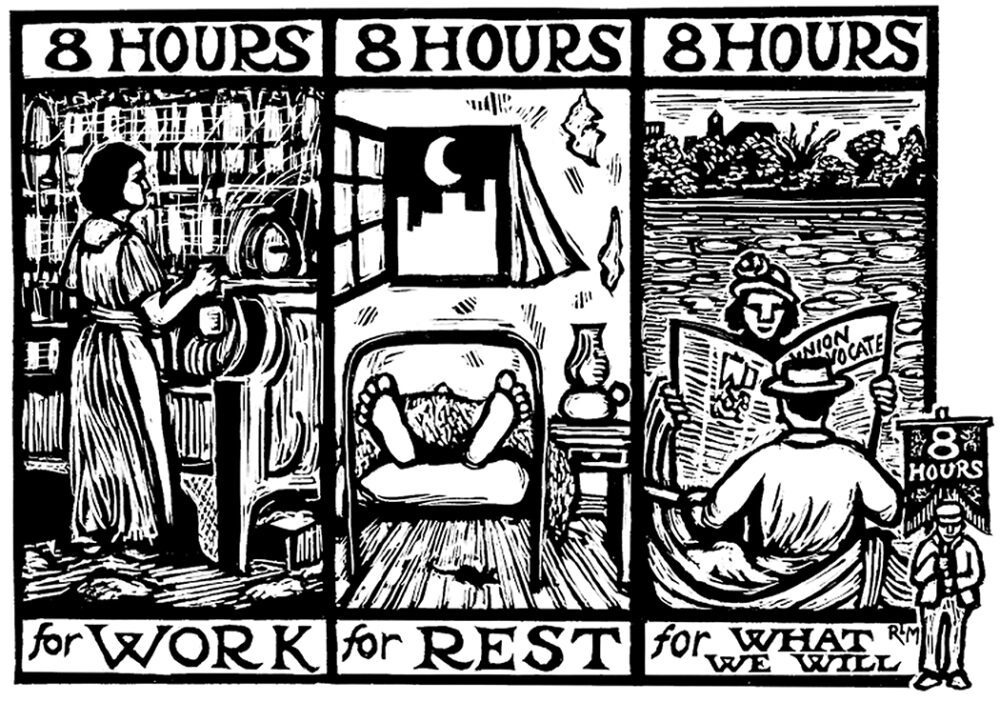
Frank and Lillian Gilbreth kind of invented efficiency as an industrial measurement. And then they had a big fight with Frederick fucking Winslow Taylor about it. See, Taylor wanted humans to be part of the machine. The Gilbreths wanted the machine to serve the humans. Taylor thought that standardizing human behavior would make better factories (and at this point, we were talking about factories). The Gilbreths advocated stools the right height for the individual worker — and easy chairs for breaks, so people could put up their feet.
This is an argument we’ve been having for over a century, and evidently, we get to keep having it.
The Gilbreths were extremely explicit – the point of increased efficiency was not more productivity (although that was a side effect), it was more happiness minutes. Happiness minutes got redefined a few times in their works, but they were always about the worker experiencing rewards, satisfaction, or leisure. Motivation wasn’t about a fear of falling behind or stack-ranking, but the joy of doing a job well and still having enough left at the end of the day to experience restoration. Fatigue Study is a great book, and I would recommend it to anyone.
The inevitable AI commentary
If AI is making us twice as efficient at tasks, why are we still working 8 hours days? Who is reaping the benefits of a putative jump in productivity?
The Gilbreths were incredibly strong union supporters. They felt that the worker had to be treated as a human and a partner in the work, not as a fragile part of the productivity firehose. And they were making these arguments against a backdrop of labor unrest and organizing the likes of which we cannot even imagine today. The Ludlow Massacre of 1914 was part of what drove the 8-hour workday of 1915. Fatigue Study was published in 1916.
Last week I talked to so many people who felt more overworked and overwhelmed. I could say it’s because of AI, but I think it’s actually because of how we’re treating AI. It’s as if we’re not budgeting our time and attention properly because there’s this frictionless surface to work on. But anyone who has walked on ice will tell you, frictionless is not the same as easy. It’s a different set of muscles, and reflexes, and dangers.
Oh, your coding harness involves supervising 3-5 agents? Has it occurred to you that supervision is work, and that’s why we have managers? Sure, you don’t have to deal with people’s messy emotional bits, but you do have to worry about whether they have the correct resources, consider their output, and evaluate and guide their direction. The average span of control for a team manager is about 11, but the median team size is about 6. Anything over about 7 and it gets real hard to be a player-coach. Look at your agents. Look at that number. Is AI use saving your time and effort, or are you just adding another half job to your job?
I’m not going to deny there are useful parts to a golem that is perfectly willing to trudge around doing easily delegated tasks. It is useful! But I keep thinking of Mickey Mouse in the Sorcerer’s Apprentice. Automation is good and useful, but animation may have unforeseen problems.

Is using AI buying us happiness minutes? Or are we trapped in a Taylorist Jevon’s Paradox, where we use AI to summarize AI-written media so that we have more time to administer our AI-generated self-rolled tools?
Closely related to Jevon’s Paradox is the Red Queen’s Paradox, and it’s the one I’m really feeling right now.
“Well, in our country,” said Alice, still panting a little, “you’d generally get to somewhere else—if you ran very fast for a long time, as we’ve been doing.”
“A slow sort of country!” said the Queen. “Now, here, you see, it takes all the running you can do, to keep in the same place. If you want to get somewhere else, you must run at least twice as fast as that!” [1]
Running faster to keep up
If everyone is putting AI generation in the same amount of time that I use to do hand-created creation, I will look slower on most objective metrics in a Taylorist-style system. Why aren’t I shoveling as much coal as the next guy? I have to use the tool if I want to “keep up”.
But what if we invert the question?
What if we say “here is a reasonable amount of work to do in this time, to this standard, and this is the value I assign to that work”? Then “time-saving” devices might actually produce happiness minutes, instead of displaced labor.
This is why when I’m a consultant, I far prefer to bill by product, rather than hour. The truth is I feel weird billing for hours that I spend mowing my lawn, consuming social media, or reading books. But that time is a part of my process. You don’t get this post, for instance, without me having read books by the Gilbreths, followed rabbit holes about the Wobblies, or scrolled BlueSky.
Sonja Drimmer is right, as is Pavel. The revolution cannot be left to the tech bros oligarchs, because they don’t care about happiness minutes for us, any more than railroad barons cared about their workers. Railroads were forced into an 8-hour day, and they hated it so much they took it to the US Supreme Court. And lost.

So what
When we hear that there is a miracle drug that can cure cancer, we are delighted. When we hear it costs 3.9 million dollars for a treatment course, we are shocked. Although it does cost a lot of money to create and test new drugs, that is not what the charge is about. It’s about what the market will bear to save a life. And that gets into murky waters fast.
But the point is that the market is terrible at understanding the value of what we do, rather than the proxy measurements, and if there’s one thing AI is the absolute best at doing, it’s generating plausible-seeming proxy measurements.
We don’t have to believe it. We have to explore value. And we have to value happiness minutes. For what we will.